
Company News
SECC Coil
2023.03.22



Source:View:
Unlocking Structural Integrity: Why Premium Carbon Steel Plates Are the Backbone of Global Infrastru
In the realm of global industrial manufacturing and heavy construction, few materials command as much fundamental importance as the carbon steel plate. Prized for its immense structural durability, excellent machinability, and cost-effectiveness, it serves as the literal foundation for modern engineering. However, maximizing project efficiency requires a deep understanding of steel classifications.
Carbon steel plates are generally categorized by their carbon content into low-carbon (mild steel), medium-carbon, and high-carbon variants. For primary structural and commercial fabrication, low and medium carbon plates are the industry workhorses due to their superior weldability and ductility.
International buyers must navigate various global grading standards to ensure compliance. The most universally recognized include ASTM A36 (the North American standard for structural steel), Q235B and Q345B (Chinese standards widely used in international trade for general and high-strength applications respectively), and EN 10025 (S235JR/S355JR) (the European structural steel standard). Selecting the precise grade determines not only the yield strength of your framework but also its performance under severe environmental stress.
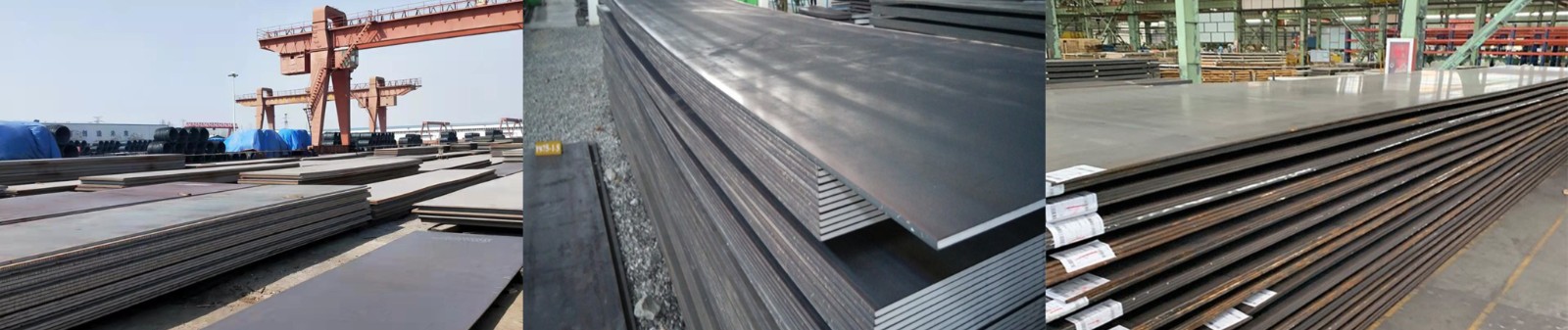
The widespread adoption of structural carbon steel plates across heavy industry is driven by an elite combination of mechanical properties. When manufactured via advanced hot-rolling mills, these plates achieve a refined grain structure that optimizes their load-bearing capacity.
Key engineering advantages include:
High Yield and Tensile Strength: Premium plates easily withstand immense load pressures, preventing structural deformation in heavy-duty machinery and skyscrapers.
Superb Fabrication Performance: Unlike highly alloyed metals, standard carbon steel offers exceptional weldability. It allows for flawless arc welding and seamless integration on construction sites without requiring intensive pre-heating processes.
Excellent Machinability: Whether your project requires high-speed CNC laser cutting, deep drilling, plasma beveling, or mechanical forming, carbon steel responds predictably, minimizing tool wear and workshop processing times.
Cost Efficiency: It provides the ultimate strength-to-cost ratio, allowing engineering firms to execute massive infrastructure projects within budget without compromising safety.
From the deep hulls of maritime cargo vessels to the sprawling frameworks of automated industrial warehouses, carbon steel plates are deployed wherever structural failure is not an option. They are the primary material for manufacturing pressure vessels, bridge girders, heavy-duty mining equipment, oil and gas storage tanks, and automotive chassis.
For global procurement managers, strategic sourcing goes beyond simply comparing prices per ton. Achieving a reliable supply chain requires partnering with suppliers who offer:
Strict Dimensional Tolerances: Consistent flatness, web thickness, and straightness are critical to preventing automated machinery jams during fabrication.
Certified Quality Compliance: Every batch must be fully traceable and backed by an official Mill Test Certificate (MTC) conforming to international audits (SGS, BV, or TUV).
Advanced Surface Treatments: Availability of downstream processing—such as shot-blasting, anti-rust priming, or hot-dip galvanizing—significantly extends the service life of the steel in corrosive outdoor or marine environments.
By aligning with a manufacturer that controls both precision milling and stringent quality assurance, global buyers can secure the structural integrity of their projects while optimizing long-term operational costs.
[Contact Us Today for a Free Quote]
Email: shuangjiu666@shuangjiusteel.com
WhatsApp/WeChat: +86-18920153189
Website: https://www.shuangjiumetal.com/

Cookies help us serve you better. By using this site, you agree to use cookies.We will not store any of your personal information. (Do not display cookies)